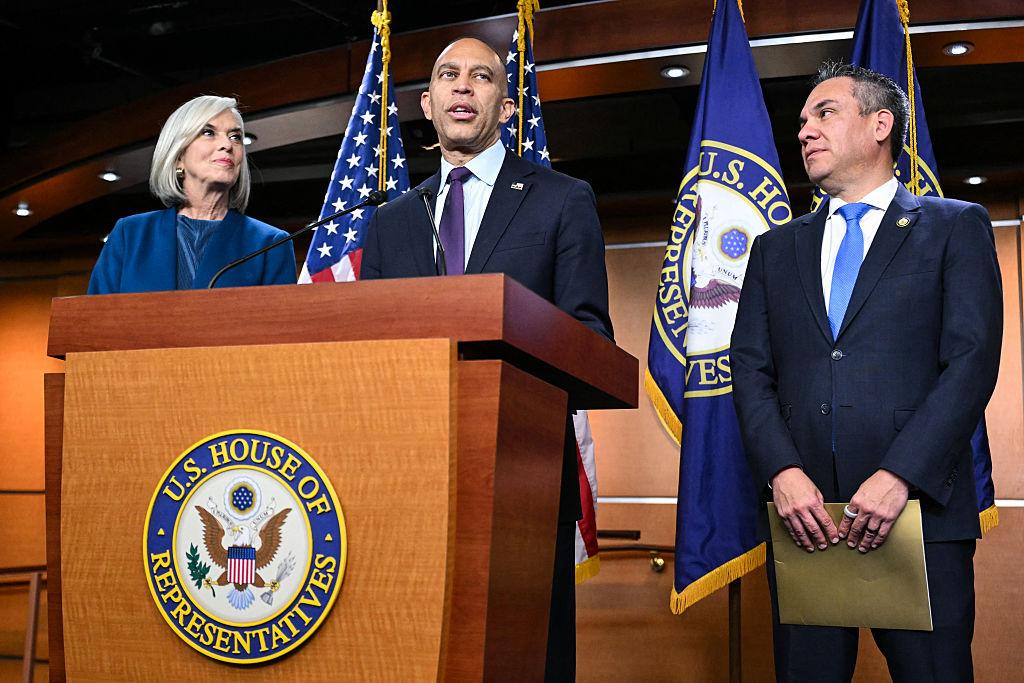
JEFFRIES WINS 251 VOTES—BUT 11 DEMOCRATS DEFY HIM
WASHINGTON, November 18, 2026 — House Democrats overwhelmingly nominated Hakeem Jeffries to become the next Speaker of the United States House of Representatives on Wednesday, placing the New York congressman on the verge of making history as the first Black American to hold one of the most powerful positions in the federal government.
The decision followed Democrats' sweeping victories in the November 3 midterm elections, which secured the party a commanding majority in the incoming House.
Jeffries received 251 votes during a closed-door Democratic leadership election.
Only 11 members voted against his nomination.
The result demonstrated broad support for the 56-year-old Democratic leader as his party prepares to take control of the chamber in January.
But the historic nomination also exposed disagreements within the party.
Several newly elected progressive Democrats refused to support Jeffries, demanding stronger commitments on healthcare, immigration enforcement, campaign finance and the war in Gaza.
Their opposition came despite the absence of an announced challenger for the speakership.
Seven incoming Democrats publicly explained their decision, saying negotiations with party leadership were continuing.
And although Jeffries is positioned to become the first Black House speaker in American history, his election is not yet official.
The full House must vote on January 3, 2027.
That vote will determine whether Jeffries formally receives the speaker's gavel.
For now, Democrats are celebrating a historic nomination while confronting difficult questions about how their new congressional majority should govern.
**DEMOCRATS NOMINATE JEFFRIES IN OVERWHELMING VOTE**
The Democratic leadership election took place behind closed doors at the U.S. Capitol.
Members of the incoming House Democratic Caucus gathered to select their nominee for speaker.
Jeffries faced no formally announced opponent.
Nevertheless, lawmakers conducted a secret-ballot vote.
The final tally was 251 in favor and 11 opposed.
The margin gave Jeffries an overwhelming victory within his party.
He needed only a simple majority of the Democratic caucus to secure the nomination.
Instead, he received support from the vast majority of members participating in the vote.
Speaking to reporters afterward, Jeffries described the nomination as an important responsibility.
He emphasized the need for Democrats to remain focused on the priorities they had presented to voters during the midterm campaign.
The incoming Democratic majority will begin governing in January.
Jeffries said the party should concentrate on delivering results rather than allowing internal disputes to dominate its agenda.
However, the 11 opposing votes demonstrated that agreement on leadership does not necessarily mean complete agreement on policy.
**A HISTORIC FIRST FOR BLACK AMERICANS**
Jeffries' nomination represents an important milestone in the history of the United States Congress.
If elected on January 3, he will become the first Black speaker of the House.
The position has existed since the founding of the federal government.
For more than two centuries, no Black lawmaker has held the speaker's gavel.
Jeffries' expected elevation would therefore mark a significant change in congressional leadership.
The historical importance of the moment was recognized by several senior Democrats.
Representative James Clyburn of South Carolina highlighted the significance of the nomination.
Clyburn has been one of the most prominent Black lawmakers in Congress and has played an important role in Democratic leadership.
He connected Jeffries' achievement to the work of earlier civil rights leaders.
The nomination also carries personal significance for Jeffries.
The Brooklyn-born congressman has frequently discussed the importance of political representation.
He has cited the example of Shirley Chisholm, the first Black woman elected to Congress.
Chisholm represented a Brooklyn district during Jeffries' childhood.
Her career became an important symbol of expanding political opportunities for Black Americans.
Jeffries now stands close to reaching an office that no Black American has previously occupied.
**ELEVEN DEMOCRATS REFUSE TO SUPPORT HIM**
Despite the overwhelming result, the nomination was not unanimous.
Eleven Democrats voted against Jeffries.
Several were newly elected lawmakers associated with the party's progressive wing.
Their opposition reflected disagreements over the direction of Democratic leadership.
The group has argued that voters expect substantial policy changes following the midterm elections.
Some progressive candidates campaigned on promises to challenge established political practices.
They have called for changes involving healthcare, immigration enforcement and the influence of money in politics.
Other concerns involve American policy toward Israel and the war in Gaza.
The opposing lawmakers have sought commitments from Jeffries before offering their full support.
However, their objections did not prevent him from receiving the nomination.
With 251 votes, Jeffries demonstrated that he maintains broad support across the caucus.
The remaining challenge is political rather than mathematical.
He must find a way to manage disagreements while leading a party that includes lawmakers with substantially different priorities.
**SEVEN PROGRESSIVES EXPLAIN THEIR OPPOSITION**
Following the vote, seven incoming Democratic lawmakers issued a joint statement explaining their decision.
The group included Darializa Avila Chevalier of New York, Adam Hamawy of New Jersey, Frederick Haynes of Texas and Melat Kiros of Colorado.
It also included Donavan McKinney of Michigan, Chris Rabb of Pennsylvania and Claire Valdez of New York.
The lawmakers said discussions with Jeffries had produced progress.
But they maintained that additional commitments were necessary.
Their priorities included expanding access to healthcare through Medicare for All.
They also called for changes to immigration enforcement and the operation of detention facilities.
Another major concern involved reducing the influence of wealthy donors and corporate interests in American politics.
The group additionally sought changes to U.S. policy concerning Gaza.
The statement did not announce a permanent break with Democratic leadership.
Instead, the lawmakers indicated that negotiations would continue.
Their opposition therefore represented an attempt to influence the party's agenda before the new Congress begins.
Whether those discussions lead to specific policy agreements remains uncertain.
**PROGRESSIVES DEMAND A DIFFERENT AGENDA**
The disagreement reflects a wider debate within the Democratic Party.
Progressive lawmakers argue that the party should pursue an ambitious legislative program after winning control of Congress.
Their priorities often include broader government healthcare programs, stronger worker protections and changes to immigration policy.
Some also advocate reducing the role of private money in elections.
Moderate Democrats may share certain objectives while disagreeing over proposed methods or the political consequences of particular policies.
The incoming House majority includes representatives from districts with different political characteristics.
Some were elected in strongly Democratic areas.
Others won competitive races in districts previously represented by Republicans.
Several incoming Democrats also captured districts that Donald Trump carried in the 2024 presidential election.
These differences create competing expectations for the party's leadership.
A policy popular in one district may generate opposition in another.
Jeffries will need to consider those differences as lawmakers debate legislation.
The challenge is not simply achieving agreement on broad political goals.
It involves deciding which proposals should receive priority and how much compromise members are prepared to accept.
**JEFFRIES CALLS FOR DEMOCRATIC UNITY**
Jeffries responded to the dissent by emphasizing the need for Democrats to work together.
At his news conference, he argued that the party should focus on its disagreements with Republicans rather than internal divisions.
He specifically criticized what he described as MAGA extremism.
That characterization reflected Jeffries' political position toward President Trump's movement.
The Democratic leader said the party needed to accomplish major legislative goals on behalf of American voters.
He also emphasized that differences of opinion would continue to exist within the caucus.
The response suggested that Jeffries was attempting to avoid a prolonged confrontation with the progressive lawmakers.
He did not announce punitive measures against the members who opposed him.
Nor did the vote produce an immediate leadership challenge.
Other senior Democrats also minimized the significance of the dissent.
Representative Rosa DeLauro of Connecticut acknowledged that political disagreements are common.
Representative Jonathan Jackson of Illinois argued that a majority can function without requiring complete uniformity.
Their comments reflected the position of lawmakers seeking to preserve unity after the election.
But the opposing votes demonstrated that the new majority will still face internal negotiations.
**DEMOCRATS WIN COMMANDING HOUSE MAJORITY**
Jeffries' nomination followed a major change in the balance of power in Washington.
Democrats won control of the House during the November 3 midterm elections.
Their victories included competitive districts across the country.
According to Reuters, Democrats had secured at least 257 seats when the leadership vote took place.
Several closely contested races remained unresolved.
That gave the party a substantial advantage over Republicans in the incoming chamber.
The results created a clear path for Jeffries to become speaker.
A candidate generally needs a majority of votes cast for a named person in the full House election.
If all 435 members vote for a candidate, the threshold is 218.
With at least 257 Democratic seats, Jeffries has considerable room to accommodate some defections.
However, the leadership nomination and the official speaker election are separate procedures.
The November 18 vote selected the Democratic nominee.
The January 3 vote will determine who actually holds the office.
That distinction means Jeffries remains the prospective speaker rather than the formally elected speaker.
**THE JANUARY 3 VOTE WILL DECIDE EVERYTHING**
The next major step is scheduled for January 3, 2027.
That is when the new House of Representatives will convene.
Members will vote to elect the speaker.
The entire chamber will participate, including Republicans.
The speaker election is one of the first and most important decisions made by a newly assembled House.
Until a speaker is chosen, the chamber cannot fully organize its legislative business.
The winning candidate must secure the required majority.
Democrats' large seat advantage gives Jeffries a strong numerical position.
Even if the 11 Democrats who opposed his nomination were to maintain that position, the party's reported seat total would leave enough potential votes to elect him, assuming the remaining Democrats supported him.
Nevertheless, party nomination does not legally guarantee the outcome.
Individual members retain the ability to vote differently when the full House convenes.
The final result will depend on the votes actually cast.
Jeffries has several weeks to continue discussions with lawmakers before that election.
**SPEAKER HOLDS ONE OF WASHINGTON'S MOST POWERFUL JOBS**
The speaker of the House occupies a central position in the American political system.
The office provides leadership over the House of Representatives.
The speaker also plays a major role in the chamber's legislative agenda.
Working with party leaders and House committees, the speaker helps determine which legislation receives consideration.
The office is especially important during disputes involving federal spending, government funding and major policy proposals.
The speaker also serves second in the presidential line of succession, behind the vice president.
That responsibility makes the position one of the highest offices in the federal government.
For Jeffries, becoming speaker would represent a major change from his current role as minority leader.
Minority leaders seek to influence legislation while their party lacks control of the chamber.
Speakers must lead a governing majority.
That involves coordinating legislation, managing committee relationships and maintaining sufficient support for major votes.
It also requires negotiations with the Senate and the White House.
The responsibilities will become particularly complicated because President Trump remains in office.
**TRUMP FACES A NEW DEMOCRATIC HOUSE**
The midterm elections changed the political environment facing President Donald Trump.
Republicans controlled the House before the election.
Democrats will take over in January.
That shift could significantly affect the administration's legislative agenda.
The House has authority over federal spending legislation and plays a central role in congressional oversight.
A Democratic majority can conduct hearings and investigations.
It can also challenge administration policies through legislation and budget negotiations.
However, control of the House does not give Democrats unilateral authority over the federal government.
Legislation generally requires approval from both chambers of Congress and the president's signature, unless a veto is overridden.
The incoming Democratic leadership will therefore face decisions about negotiations and oversight.
Jeffries has emphasized affordability and accountability as major priorities.
Democratic lawmakers have also criticized several policies associated with the Trump administration.
Republicans, meanwhile, continue defending their own policy agenda.
The change in House control sets the stage for a new period of political negotiations and legislative conflict.
**REPUBLICANS SELECT JIM JORDAN AS THEIR LEADER**
Republicans have also made leadership decisions ahead of the new Congress.
The party selected Representative Jim Jordan of Ohio to lead its House conference in the minority.
Jordan defeated Representative Steve Scalise of Louisiana in the Republican leadership contest.
The election followed Speaker Mike Johnson's decision not to seek leadership of the party after its loss of House control.
Jordan is known for his prominent role in Republican congressional politics.
He has also been a strong supporter of Trump.
His selection means the new House will have different leadership arrangements on both sides.
Jeffries is positioned to lead the Democratic majority.
Jordan will lead Republicans in opposition.
The two lawmakers have substantially different political priorities.
Their interactions could influence debates over government spending, investigations and legislation.
However, the new leadership structure will not be formally established until the next Congress begins.
The immediate focus remains on the January transition.
**KATHERINE CLARK MAKES HISTORY IN LEADERSHIP**
Jeffries is not the only Democrat positioned to achieve a historic milestone.
Representative Katherine Clark of Massachusetts was selected to serve as the incoming House majority leader.
If she assumes the role as planned, she will become the first woman to hold that specific leadership position.
Clark has worked closely with Jeffries in the Democratic leadership team.
Her responsibilities will include helping coordinate legislative priorities and building support among party members.
The majority leader plays an important role in managing the House's legislative schedule.
Clark's promotion follows years of experience in congressional leadership.
Her elevation also reflects continuity within the Democratic caucus.
Rather than replacing the entire leadership team after winning the midterms, Democrats chose to promote established leaders into majority positions.
That arrangement could provide organizational stability.
But the leadership will still need to accommodate newly elected members with different political priorities.
Clark's role will therefore involve both legislative management and internal party coordination.
**PETE AGUILAR BECOMES FIRST LATINO MAJORITY WHIP**
Representative Pete Aguilar of California was selected as the incoming majority whip.
He is positioned to become the first Latino to serve in that role.
The majority whip helps party leadership track support for legislation and coordinate votes.
The position is particularly important when proposed legislation faces opposition from members of the majority party.
Whips communicate with lawmakers and help identify concerns before major votes occur.
Aguilar has been part of the leadership team alongside Jeffries and Clark.
His continued role reinforces the caucus's decision to maintain its existing leadership structure.
The incoming team will represent several historic firsts.
Jeffries could become the first Black House speaker.
Clark is positioned to become the first female majority leader.
Aguilar will become the first Latino majority whip.
Representative Ted Lieu of California was also elected Democratic caucus chair.
His selection makes him the first Asian American to hold that leadership position.
Together, the appointments represent notable changes in the diversity of congressional leadership.
**NANCY PELOSI WELCOMES THE HISTORIC NOMINATION**
Former House Speaker Nancy Pelosi was among the prominent Democrats who supported Jeffries' nomination.
Pelosi became the first woman to serve as speaker of the House in 2007.
Her leadership represented a major milestone in congressional history.
Jeffries succeeded Pelosi as the leader of House Democrats in 2023.
That transition made him the first Black lawmaker to lead either major party in Congress.
The November 18 nomination moved him closer to another historic achievement.
Pelosi attended the Democratic leadership proceedings and publicly supported Jeffries.
The relationship between the two lawmakers illustrates the transition from one generation of congressional leadership to another.
However, Jeffries will face a different political environment.
Democrats are entering the new Congress after a sweeping electoral victory.
The party's coalition includes both longtime lawmakers and newly elected candidates calling for changes.
Managing that coalition may require different approaches from those used when Democrats were in the minority.
Pelosi's support provides continuity.
But Jeffries will be responsible for establishing his own leadership record.
**SHIRLEY CHISHOLM'S LEGACY RETURNS TO THE SPOTLIGHT**
Jeffries used the moment to reflect on Shirley Chisholm's political legacy.
Chisholm became the first Black woman elected to the House of Representatives in 1968.
She represented a Brooklyn district and later pursued the Democratic presidential nomination.
Her career helped expand political representation at the national level.
Jeffries grew up in Brooklyn during the period when Chisholm served in Congress.
He has described her example as important to his understanding of public service.
The connection gave his nomination additional historical significance.
More than half a century after Chisholm entered Congress, a Black lawmaker is positioned to become speaker.
However, the historical milestone does not resolve the political challenges facing the incoming majority.
Representation and governance are related but distinct questions.
Jeffries' supporters have emphasized the significance of his expected elevation.
His critics within the party are demanding concrete policy commitments.
Both developments were visible during Wednesday's leadership election.
**THE DEMOCRATIC LEFT CONTINUES TO APPLY PRESSURE**
The 11 opposing votes demonstrated that some progressive lawmakers intend to challenge leadership decisions.
Several incoming members have argued that Democrats must respond more directly to voters demanding major changes.
Their concerns extend beyond the speakership.
They involve the party's priorities after taking control of Congress.
Healthcare remains one major issue.
Some progressives favor establishing a Medicare-for-All system.
Immigration policy is another source of disagreement.
Several lawmakers want substantial changes to federal immigration enforcement and detention practices.
Campaign finance reform also remains central to their demands.
The group has additionally criticized U.S. policy toward Israel and called for changes involving Gaza.
These positions are not uniformly shared by all House Democrats.
The caucus includes members who favor more limited reforms.
That difference could influence legislative negotiations.
Jeffries has indicated that he intends to work with members across the party's ideological spectrum.
Whether that approach produces agreement on specific policies remains uncertain.
**NEW LAWMAKERS WANT A GREATER VOICE**
The incoming Democratic majority includes a substantial number of newly elected members.
Some entered politics after campaigning against established party leadership practices.
Their victories have increased pressure for changes inside Congress.
Several have argued that winning elections should lead to policy commitments reflecting their campaign promises.
Those expectations were visible during the speaker nomination process.
The lawmakers opposing Jeffries did not organize a successful challenge for the leadership position.
Instead, they used their votes to express dissatisfaction and seek additional negotiations.
The tactic has drawn different reactions within the caucus.
Some Democrats believe the opposition reflects legitimate concerns from newly elected representatives.
Others argue that prolonged leadership disputes could distract the party from governing.
The debate highlights the tension between party unity and the independence of individual lawmakers.
Members must represent their districts while participating in a national legislative coalition.
Jeffries will need to balance those responsibilities as the new Congress begins.
**AFFORDABILITY AND ACCOUNTABILITY BECOME CENTRAL PRIORITIES**
Democratic leaders have emphasized affordability and accountability following the midterm elections.
The party campaigned on concerns about living costs and government policy.
Jeffries has indicated that these issues will remain central to the incoming House majority.
Affordability encompasses several policy areas.
Housing costs, healthcare expenses and household budgets have been major subjects of political debate.
Government accountability may involve congressional oversight and investigations.
However, broad political priorities do not automatically translate into legislation.
House leaders must develop proposals capable of winning majority support.
Those proposals may then face negotiations with the Senate and the White House.
Different Democratic factions could also disagree over which policies should come first.
The party's large majority gives leaders flexibility.
But it does not eliminate the need for compromise.
The next Congress will provide the first major test of whether the incoming leadership can turn campaign commitments into legislative action.
**WHAT HAPPENS NEXT?**
The next major date is January 3, 2027.
That is when the newly elected House of Representatives will convene and vote for speaker.
Jeffries enters the process with overwhelming support from his Democratic colleagues.
His party has secured a commanding majority.
The November 18 nomination demonstrates that most incoming Democrats support his leadership.
However, the full House has not yet elected him.
The 11 opposing votes also show that some progressive lawmakers remain dissatisfied.
Negotiations involving healthcare, immigration, campaign finance and foreign policy priorities are expected to continue.
The outcome of those discussions could affect how Democrats organize their legislative agenda.
Meanwhile, the party's incoming leadership team is preparing to assume new responsibilities.
Katherine Clark is positioned to become majority leader.
Pete Aguilar will serve as majority whip.
Ted Lieu has been selected as caucus chair.
Republicans are preparing to enter the minority under Jim Jordan.
The leadership changes will take place as President Trump confronts a Congress with a different balance of power.
For Jeffries, the transition carries both historical significance and political responsibility.
He is positioned to become the first Black speaker in American history.
But reaching that milestone is only the beginning of the challenge.
He will need to manage a large Democratic majority that includes moderates, progressives and lawmakers representing competitive districts.
He will also face difficult legislative negotiations with Republicans and the White House.
The November 18 vote provided a clear demonstration of his support within the party.
It did not establish complete agreement on the policies the new majority should pursue.
For now, the facts are clear.
Jeffries won 251 votes.
Eleven Democrats opposed his nomination.
No rival candidate defeated or displaced him.
And Democrats have enough seats to place him in a strong position for the January speaker election.
The historical milestone is close.
But the final vote has yet to take place.
On January 3, the new House will determine whether Hakeem Jeffries formally becomes the first Black speaker of the United States House of Representatives.
Until then, the 251-to-11 nomination stands as both a major political achievement and an early indication of the debates awaiting the next Democratic majority.